Product Description
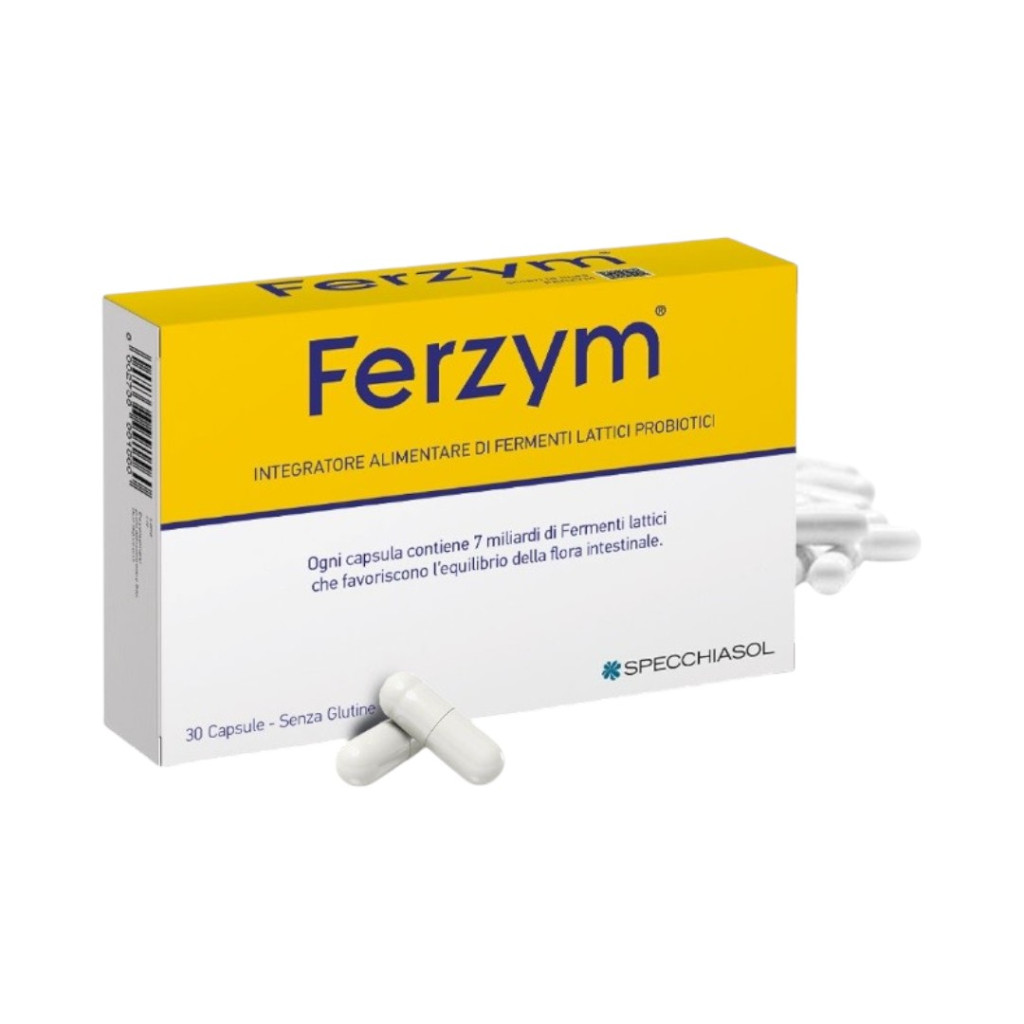
Ferzym® is a microbiome nourishing dietary supplement deposited in an international strain collection with 21 billion probiotics in 3 capsules, complemented with synergistic prebiotics and B vitamins for a healthy immune system!
- MICROORGANISMS DEPOSITED IN AN INTERNATIONAL COLLECTION OF MICROORGANISMS
- PRODUCED WITH INNOVATIVE MANUFACTURING TECHNOLOGY
- STABLE INTESTINAL BACTERIA PREPARATION
- SYNERGISTIC WITH PREBIOTICS
- 21 BILLION LIVE FLORA IN 3 CAPSULES
- ALSO SUITABLE FOR USE DURING ANTIBIOTIC TREATMENT
- WITH 7 TYPES OF B-VITAMINS
- TITANIUM DIOXIDE FREE FORMULA
- ARTIFICIAL PRESERVATIVES, COLORINGS, AND FLAVORS FREE
- GLUTEN-FREE, SUITABLE FOR CHILDREN FROM 3 YEARS OLD
- WITH BENEFICIAL BACTERIAL STRAINS FOUND IN THE HEALTHY HUMAN INTESTINAL MICROBIOTA
- Vitamins B6, B12, and folic acid contribute to the healthy functioning of the immune system.
Especially suitable for children, as it contains a strain of Bifidobacteria which has been scientifically proven to be the first to colonize the gastrointestinal tract.
FERZYM® - INNOVATIVE MANUFACTURING TECHNOLOGY
The innovative manufacturing technology ensures the safe delivery of beneficial bacteria to the colon and enables them to colonize and multiply effectively.
During production, probiotics are manufactured under special humidity and temperature conditions using a unique mixer to minimize mechanical stress on the live bacteria and ensure the survival of probiotic cultures.
During production, prebiotics and lyophilized live flora extracted from algae are enriched with sodium alginate, which forms a gel around the microorganisms when it comes into contact with stomach acid, aiding their safe passage - under varying pH conditions - all the way to the colon flora.
DID YOU KNOW? THERE ARE 1.5 KG OF MICROORGANISMS LIVING IN THE INTESTINES!
The first recorded instances of humans consuming live bacteria are over 2000 years old. It's incredible to think that 70% of our immune system is in the hands of tiny, invisible microorganisms that cannot be seen with the naked eye. These microorganisms, which influence our health, digestion, well-being, and beauty, make up the gut microbiota.
The microenvironment of the gastrointestinal system contains approximately 10^14 bacterial cells, belonging to around 30 genera comprising 400-500 species, forming a highly complex ecological system with a total weight of 1.5 kg!
The gut flora, unique as a fingerprint
The gut flora is unique to each individual, just like fingerprints, therefore, the presence of prebiotics is essential in addition to probiotics in its personalized establishment, enabling individual-specific species to colonize. To maintain the balance of the gut flora, an 85% majority of acidophilus and bifidus species (beneficial gut bacteria, probiotics) is required.
During life, the composition of the gut microbiota changes significantly. The gastrointestinal tract is sterile at birth, and colonization of the gut microbiota begins after birth, which occurs in parallel with cognitive development and influences brain development and later adult behavior and cognitive function.
Unfortunately, it is very easy to disrupt the balance of gut bacteria and to maintain this state. Everyday things like a diet high in gluten, caffeine, and sugar, stress or poor sleep habits, exposure to antimicrobial agents in foods, cleaning products, and medications all decrease the number of beneficial gut bacteria and can shift the balance towards pathogenic microorganisms.
THE GUT-BRAIN AXIS
The latest research has uncovered communication pathways between the brain, the gut, and the microbiota. The gut, its microbiota, and the brain are connected in a complex communication and regulatory system known as the gut-brain axis (also referred to as the brain-gut axis, microbiota-gut-brain axis, or gut-brain relationship).
This is a bidirectional signaling network composed of neurons, hormones, immune cells, and microbial molecules. It is part of a larger system that provides information to the brain about the internal state and health of our body, and is essential for maintaining the physiological balance known as homeostasis in the body.
THE GUT MICROBIOTA IS THE GUARDIAN OF THE IMMUNE SYSTEM
As we grow, the microbiota shapes the development of our immune system, while the immune system in turn shapes the composition of the microbiota. The beneficial gut bacteria contribute to 70% of the immune system as they prompt antibody production, produce antibacterial compounds, anti-inflammatory substances, vitamins (all B-vitamins and K-vitamin), aid in the absorption of trace elements (calcium, iron, magnesium).
The gut microbiota is a diverse ecosystem consisting of bacteria, archaea, protists, viruses, and fungal communities that reside in the human gut. The number of bacteria, viruses, and fungi present in the human body is now estimated to be equal to the number of human cells in a healthy individual. We constantly interact with the microbiome within us, making it essential for maintaining our homeostasis (internal environment stability). Various factors such as age, genetics, stress, smoking, and especially diet influence the gut microbiota, causing digestive and immune problems.
DID YOU KNOW THAT THE NUMBER OF BENEFICIAL BACTERIA IN THE GUT CAN DECREASE:
- due to antibiotic treatment
- due to chronic stress
- by changing lifestyle and diet
- Diarrhea due to viral infection
WHAT ARE PROBIOTICS AND WHAT TYPES ARE KNOWN?
The word probiotic is of Greek origin, meaning: for life, for the life. The concept of probiotics was born in 1965. According to the FAO/WHO definition, a probiotic refers to live microorganisms that, when administered in adequate amounts, have a beneficial effect on the host organism.
- Lactic acid bacteria (e.g. Lactobacilli, such as L. acidophilus, fermentum, plantarum, etc.)
- Bifidobacteria (e.g. Bifidobacterium bifidum, longum, animalis, etc.)
- Spore-forming bacteria (e.g. Bacillus species, such as Bacillus coagulans, subtilis)
- Yeast fungi (e.g. Saccharomyces boulardii)
HOW TO IDENTIFY A BENEFICIAL BACTERIUM (PROBIOTIC): LET'S TAKE A CLOSER LOOK AT LACTOBACILLUS RHAMNOSUS GG!
| Taxonomic level | Name |
| Domain | Bacterium |
| Bacterial strain | Firmicutes |
| Class | Bacilli |
| Order | Lactobacillales |
| Family | Lactovacillaceae |
| Clan | Lactobacillus |
| Species | Lactobacillus rhamnosus |
| Trunk | Lactobacillus rhamnosus GG |
It is important to learn the above information because the beneficial effects of probiotics are strain-specific, so probiotics should be described by genus, species, and strain. It is essential to understand that the properties of different probiotic species vary, so the beneficial effects of a particular bacterial strain cannot be generalized and do not apply to other strains. It is important to note that a single strain alone cannot provide all beneficial effects, and not all strains of a certain species are capable of doing so.
A MICROORGANISM CAN BE CONSIDERED A PROBIOTIC IF THE FOLLOWING CONDITIONS ARE MET:
- be appropriately isolated from the human body
- It should not be a pathogenic (harmful) bacterium and should not cause disease.
- Resist the secretions of the gastrointestinal tract (gastric acid, digestive enzymes, antimicrobial peptides), and maintain viability in various sections of the intestinal tract.
- During the individual food processing factory technology processes, the viability should be maintained until the end of the product's shelf life.
- The beneficial effects on health should be scientifically proven.
- Avoid causing lactic acidosis (acidification) in the small intestine, which can lead to carbohydrate malabsorption issues.
Safety is of utmost importance when it comes to probiotics, which is why the European Food Safety Authority (EFSA) has issued a so-called QPS list (Qualified Presumption of Safety), which includes microorganisms considered safe and available within the European Union.
CFU, AS AN INTERNATIONALLY ACCEPTED UNIT FOR PROBIOTICS
A CFU (colony forming unit) stands for colony forming unit, which is considered a scientifically accepted unit of measurement for probiotics and is used in research on probiotics to assess the safety and health benefits of different strains. Essentially, it indicates the number of viable bacteria/microorganisms.
Quality products must ensure the viable amount of beneficial bacteria until the end of the product shelf life (under proper storage conditions), so it is extremely important to adhere to the storage instructions for the product.
ABOUT PREBIOTICS BRIEFLY
A prebiotic is a food ingredient that is indigestible by the human body, but once it reaches the colon, it can feed the beneficial bacteria living there, helping to support their viability and promote their growth, thus indirectly supporting the overall health of the host organism. Prebiotics often exert their beneficial effects as dietary fibers.
We can call a food ingredient a prebiotic if it meets the following criteria:
- Resistant to stomach acid and digestive enzymes.
- Do not be absorbed in the upper section of the digestive tract
- the gut microbiota can metabolize
- Selective impact is important, especially on beneficial species.
To achieve the comprehensive effect of the product, we have complemented it with synergistic fructooligosaccharides (dietary fiber) and B vitamins.
LYOPHILIZED BACTERIAL STRAINS THAT DO NOT NEED TO BE STORED IN THE REFRIGERATOR
Dosage recommendation: Take 1-3 capsules daily, preferably in the morning on an empty stomach before eating.
Suitable for children aged 3 and above; the contents of the capsule can be mixed into not too hot food or drink.
Dosing duration: Minimum 60 days, maximum 120 days.
Number of servings in the product: 10-30
| Active ingredients in daily dose | 1 capsule | 2 capsules | 3 capsules |
| Short-chain fructooligosaccharides (FOS) | 80 mg | 160 mg | 240 mg |
| Total Viable Cell Count (CFU) | 7x10⁹** | 1.4x10¹⁰ | 2.1x10¹⁰ |
| Bacillus coagulans BC4 | 5x10⁹** | 1x10¹⁰** | 1.5x10¹⁰ |
| Lactobacillus acidophilus LA3 | 1x10⁹** | 2x10⁹ | 3x10⁹ |
| Bifidobacterium animalis ssp. lactis BLC1 | 1x10⁹** | 2x10⁹ | 3x10⁹ |
| Vitamins | |||
| Vitamin B1 (thiamine) | 0.4 mg (NRV 36.4%) | 0.7 mg (NRV 63.6%) | 1.1 (NRV 100%) |
| Vitamin B2 (riboflavin) | 0.5 mg (NRV 35.7%) | 0.9 mg (NRV 64.3%) | 1.4 (NRV 100%) |
| Vitamin B3 (niacin) | 5.3 mg (NRV 33.1%) | 10.7 mg (NRV 66.9%) | 16 (NRV 100%) |
| Vitamin B5 (pantothenic acid) | 2 mg (NRV 33.1%) | 4 mg (NRV 66.7%) | 6 mg (NRV 100%) |
| Vitamin B6 (pyridoxine) | 0.5 mg (NRV 35.7%) | 0.9 mg (NRV 71.4%) | 1.4 mg (NRV 100%) |
| Vitamin B9 (Folic acid) | 66.7 mcg (NRV 33.4%) | 133 mcg (NRV 66.5%) | 200 mcg (NRV 100%) |
| Vitamin B12 (cobalamin) | 0.8 mcg (NRV 32%) | 1.7 mcg (NRV 68%) | 2.5 mch (NRV 100%) |
CFU: colony forming unit at the time of manufacture
** Guaranteed amount of active substance until the end of shelf life (without cooling)
NRV: Nutrient Reference Value for adults.
Warning:
- Do not exceed the recommended daily intake!
- Dietary supplements do not substitute a balanced, varied diet and a healthy lifestyle.
- During antibiotic treatment, it can be administered with a 2-hour interval after taking the antibiotic.
- The product is suitable for ages 3 and up.
- The product can be used alongside a blood thinner.
- The product is suitable for diabetes.
- The product is safe to consume during pregnancy and breastfeeding.
- Can be used both during and after antibiotic treatment.
Storage: Store in a cool, dry place, below 25°C, with relative humidity not exceeding 70%, protected from direct sunlight, heat, and moisture, and out of reach of children!
Ingredients: short chain fructooligosaccharide (FOS; dietary fiber), capsule shell (gelatin), corn starch, live flora blend [Bacillus coagulans SNZ 1969 (BCCM/LMG S-27484), Lactobacillus acidophilus LA3 (DSM 17742), Bifidobacterium animalis ssp. lactis BLC1 (DSM 17741)], anticaking agents (silicon dioxide, magnesium fatty acids), nicotinamide, calcium-D-pantothenate, pyridoxine hydrochloride, riboflavin, thiamine hydrochloride, stabilizer (sodium alginate), pteroylmonoglutamic acid, cyanocobalamin.